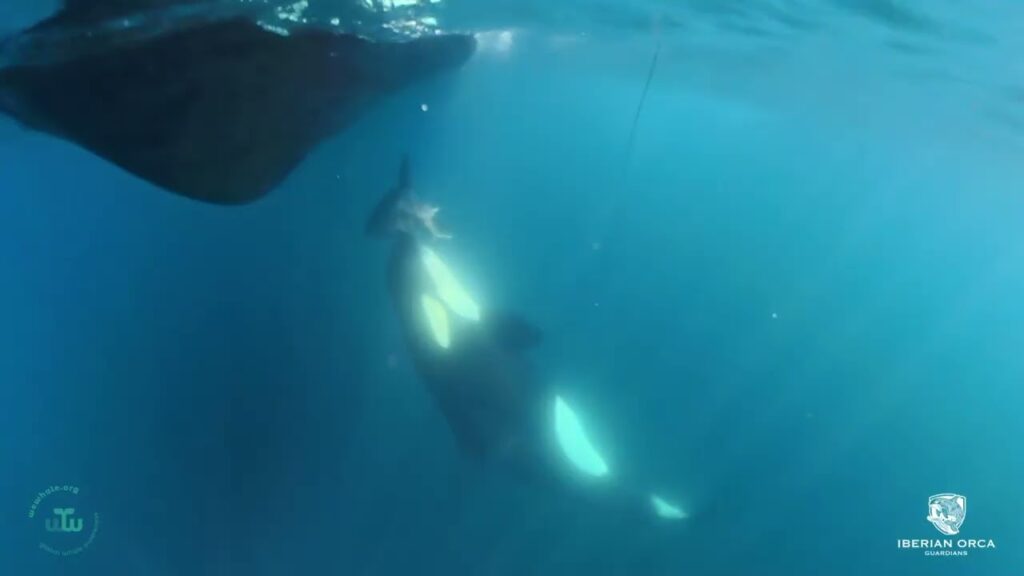
WeWhale Association releases new footage of Estrella, also known as “White Gladis”, during fieldwork of the Save The Iberian Orca Campaign
For years, Estrella has been described in headlines around the world as a “boat-attacker”, a “revenge-seeking orca” and one of the animals behind the widely publicised interactions between Iberian orcas and sailing vessels.
But the footage released by WeWhale Association shows a very different moment.
Estrella approaches the boat calmly with the head of a tuna, brings it up and leaves it close to the hull, and then appears to wait and observe what happens next.
The encounter took place during one of the regular field days of the Save The Iberian Orca Campaign in June 2026.
“This is one of the most powerful moments we have ever documented in the field,” said Janek Andre, Founder and President of WeWhale Association and Co-Founder of the Iberian Orca Guardians Foundation. “In the footage, we clearly see Estrella bringing the tuna to our boat, leaving it there, and then waiting to see what we do. This is the same individual the world has been told to fear as ‘White Gladis’, the boat-attacking orca. But what we see here is not a monster. We see curiosity, intelligence and a level of social complexity that should make all of us pause before repeating the same old headlines.”
WeWhale Association stresses that the footage should not be used to romanticise orcas or to ignore the reality that vessel interactions can be frightening and dangerous for sailors. Instead, the association says the footage highlights why the public conversation around Iberian orcas urgently needs to move away from sensationalism and towards coexistence, safety and science.
The behaviour also connects to recently published scientific work on prey offering by wild orcas. The publication “Testing the Waters: Attempts by Wild Killer Whales (Orcinus orca) to Provision People (Homo sapiens)” documents cases from different parts of the world in which wild orcas offered prey or other items to people. In many of those cases, the orcas waited for a human response before reacting further.
“Prey sharing and prey offering are deeply important behaviours in orca societies,” said Cristina Otero Sabio, marine biologist and field researcher at WeWhale Association and Iberian Orca Guardians. “Such behaviours may be related to social learning, bonding, curiosity or communication. In this case, we cannot say with certainty what Estrella’s intention was, but the sequence is remarkable and worth noting”.
The Iberian orca population is critically endangered and depends heavily on Atlantic bluefin tuna. Only a small number of individuals remain, and each animal is known through long-term observation, photo-identification and family relationships.
Estrella is not simply a name in the headlines. She is an individual orca, a mother, a hunter and a member of one of Europe’s most endangered marine mammal populations.
“This footage does not erase the fact that interactions with boats are a serious issue,” said Alexandra Johnston, orca expert and conservationist at WeWhale Association and Iberian Orca Guardians, who has been working with the campaign for two years. “But it challenges the way these animals have been portrayed. If we want sailors to be safe and orcas to be protected, we need to understand behaviour instead of demonising individuals. Fear alone will not create coexistence. Knowledge, respect and responsible action will.”
Through the Save The Iberian Orca Campaign, WeWhale Association, Iberian Orca Guardians Foundation, Sea Shepherd France and Voluntarios Trafalgar work to provide sailors with practical safety information in areas used by the Iberian orcas. The campaign promotes precautionary navigation, awareness of orca presence, responsible behaviour at sea and non-invasive research to better understand the population’s movements, social structure and behaviour.
According to Janek Andre, the way Iberian orcas are described matters. Words such as “attack”, “revenge” or “war against boats” can shape public perception and potentially fuel hostility towards a critically endangered population.
“This campaign has always been about two things at the same time: orca protection and sailor safety,” added Andre. “We do not need to choose between people and orcas. We need to learn how to share the same waters. Estrella bringing tuna to our boat does not answer every question, but it does dismantle the idea that she can be reduced to a bloodthirsty boat-attacker. She is not a headline. She is Estrella. And in that moment, she brought her food to us.”
WeWhale Association will publish the footage as part of its ongoing awareness work, using the moment to explain prey offering, orca social behaviour and the importance of replacing fear-based narratives with safety, science and coexistence.
The footage was collected under permit from the Ministerio para la Transición Ecológica y el Reto Demográfico. Permit reference: SGBTM/BDM/AUTSPP/41/2026
About WeWhale Association
WeWhale Association is a marine conservation organisation dedicated to the protection of whales, dolphins and their habitats. Its work focuses on field-based conservation, public education, non-invasive research and awareness campaigns, with a special focus on the critically endangered Iberian orca population.
Scientific reference
Towers, J. R., Visser, I. N., & Prigollini, V. “Testing the Waters: Attempts by Wild Killer Whales (Orcinus orca) to Provision People (Homo sapiens)”, Journal of Comparative Psychology. DOI: 10.1037/com0000422